31. TCP IP
TCP/IP is the most widely used network protocol suite. It is not one single protocol, but a group of protocols used for communication across networks.
It was developed before the OSI model and focuses on the core functions needed for real-world networking.
TCP/IP has four layers:
- Application Layer – provides protocols used by applications and service
- Transport Layer – moves data between devices
- Internet Layer – handles packet creation and logical addressing
- Network Interface Layer – handles how data moves across the physical network
Main protocols
At the Transport Layer, the two main protocols are:
- TCP – connection-oriented and reliable
- UDP – connectionless and faster, but with less reliability
At the Internet Layer:
- IP handles addressing and routing
- ICMP is used for network status, error reporting, and tools like ping and traceroute
- IGMP is used for multicast group management
At the Application Layer:
- FTP
- TFTP
- Telnet
- SMTP
- SNMP
- NFS
At the Network Interface Layer:
- Ethernet
- Fast Ethernet
- Token Ring
- FDDI
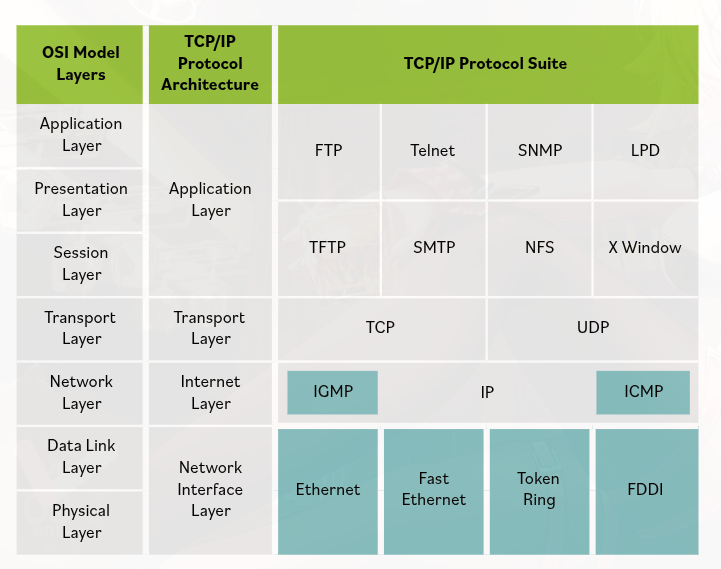
TCP/IP vs OSI
TCP/IP has 4 layers, while OSI has 7.
The TCP/IP Application Layer covers the OSI Application, Presentation, and Session layers.
The TCP/IP Network Interface Layer covers the OSI Data Link and Physical layers.
Main Idea
TCP/IP is the standard protocol suite for networking, using layered protocols to handle application communication, transport, addressing, and network access.